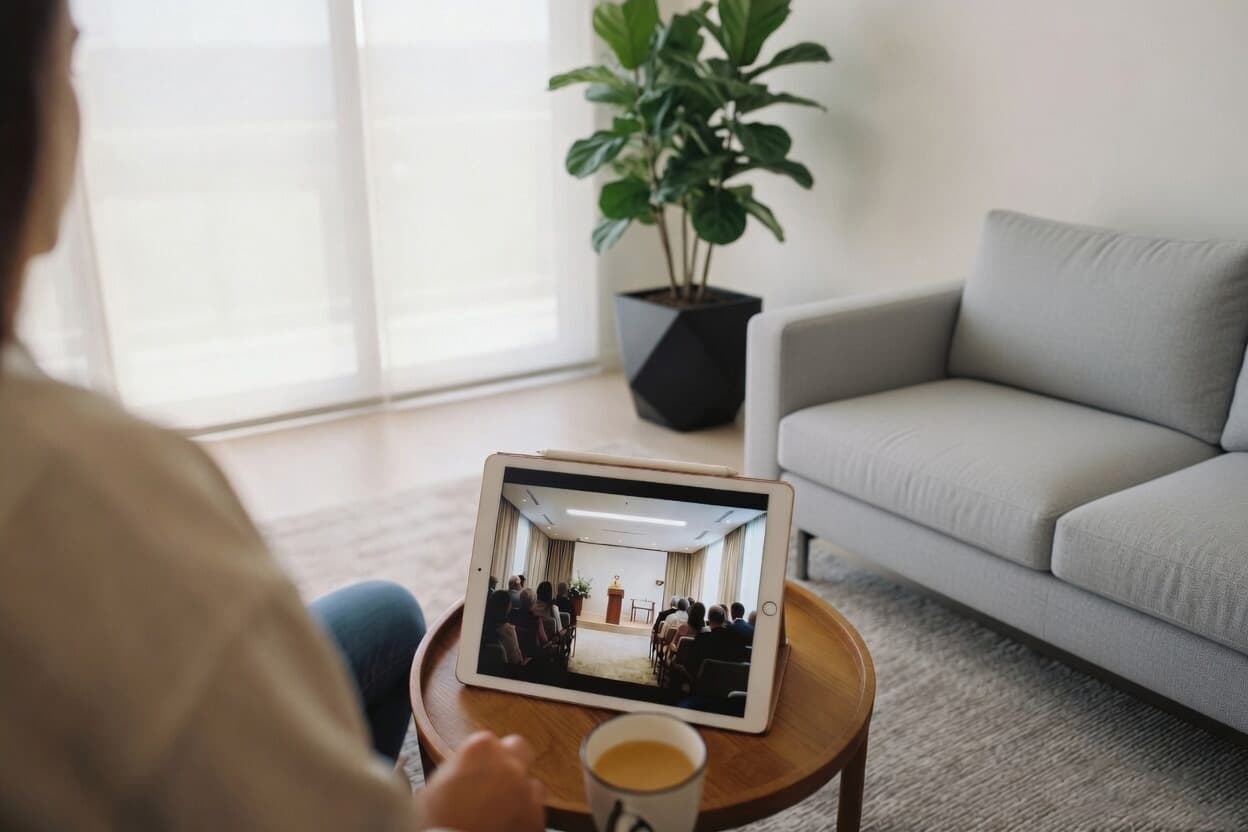
Funerals have always been about presence: being there, sitting alongside others, and sharing in a moment that marks the end of a life and the beginning of remembrance. For generations, that presence was defined physically. You either made it into the room—or you did not.
But the way we live has changed. Our relationships now stretch across cities, countries, and continents. Families are more dispersed. Communities are broader. The people who matter most are not always able to be in the same place at the same time.
Why livestream a funeral service?
Livestreaming allows presence to extend beyond physical boundaries. For those who cannot travel—because of distance, health, timing, or circumstance—it offers a way to still be there in a meaningful sense. Not perfectly. Not fully. But genuinely.
Technology now makes this seamless. Services like Memories Stream allow families to both livestream and record the service with minimal intrusion—ensuring that those who cannot attend are still included, and that the moment itself is preserved.
Who benefits from a funeral livestream?
The most obvious answer is those who cannot travel. But the benefit extends further than that. People who are unwell. Those managing young children. Friends from earlier chapters of a life who have drifted geographically but not emotionally. Colleagues who want to pay their respects without intruding on a family gathering. In almost every service, there are people who would be there if they could. Livestreaming means they can.
Why record a funeral — not just livestream it?
While livestreaming serves the present moment, recording serves something deeper. A funeral is not just an event. It is a moment that carries a kind of emotional weight that is rarely repeated. The eulogies are different. The stories are more honest. The emotions sit closer to the surface.
There is something distinct about the tone of a funeral: a certain stillness, a certain clarity. Even carefully written words take on a different meaning when spoken in that setting, shaped by grief, by presence, and by the awareness of finality. A recording captures that—not as a polished production, but as something real.
Many people hesitate to record a funeral because they cannot imagine ever wanting to revisit it. That instinct is understandable. In the immediate aftermath of loss, the experience can feel too raw. But time changes perspective. What feels overwhelming today often becomes something else later: a way to hear a loved one’s story again, to revisit what was said, and to reconnect with the presence of those who gathered.
What does a recording become over time?
A funeral service is often the most complete reflection of a life that exists in one place. Recording it creates something that can be passed forward—to children, grandchildren, and those who were too young, too far away, or not yet born to be there. It allows them not just to know about the person, but to witness how they were remembered.
Choosing to record does not mean you must revisit the service. It simply means you can. It is an act of preservation, not obligation. And for many families, that option becomes more meaningful with time.
How a recording becomes part of something larger
When combined with a digital space, a recording becomes part of something larger. Within a Memories Online Memorial, a service recording can live alongside a tribute video, written tributes, photographs, guest book messages, and shared memories — becoming one part of a broader and evolving reflection of a life.
In the end, recording a funeral does not change the fact that the moment cannot be repeated. But it does allow the moment to remain accessible—to be returned to, if and when the time feels right. What feels like pain today may, over time, become perspective, connection, and understanding. In preserving that moment, you are not holding onto grief. You are holding onto meaning.